11/08/2026 General News, Latest News
Hutchinson Scott is delighted to present The Fine Clock Sale, a specialist auction of 208 clocks taking place at Embsay Mills, Skipton, on 1 September 2026. From highly decorative French carriage clocks to distinguished English longcase, bracket and lantern clocks, the sale brings together centuries of horological skill, design and mechanical ingenuity.
The Fine Clock Sale catalogue offers collectors the opportunity to explore an extensive range of antique clocks in one focused auction. Bidding will be available online, in person and by telephone, with viewing at Embsay Mills before the sale. Further specialist information can be found through our Clocks and Barometers department.
When assessing an antique clock, collectors often look closely at the maker, movement, case, dial, originality, condition and provenance. A respected signature can be important, but quality and completeness matter too. Original movements paired with their intended cases, finely finished mechanisms and well-preserved decorative details can all strengthen a clock's appeal at auction. Buyers can review our auction buying information before registering.
Among the outstanding antique clocks in The Fine Clock Sale are four timepieces that demonstrate the remarkable breadth of specialist horology. A fine Art Deco Cartier minute-repeating desk clock combines silver and guilloché enamel with sophisticated mechanics, while a rare St Paul's Cathedral skeleton clock, attributed to Smiths of Clerkenwell, celebrates Victorian architectural design. A Frederick Miller triple-fusee mantel clock made for the Chinese market represents the international reach of late 18th-century London clockmaking, and a Jaeger-LeCoultre Atmos Phases de Lune brings the selection into the modern era. Together, these unusual and collectable clocks offer buyers searching for rare clocks at auction an exceptional mixture of artistry, technical complexity and historic character.

A fine Art Deco Cartier minute-repeating silver and guilloché enamel desk clock.
Estimate: £8,000–£12,000
View Lot
A rare mid-19th-century St Paul's Cathedral three-train quarter-striking skeleton clock, attributed to Smiths of Clerkenwell.
Estimate: £8,000–£12,000
View Lot
Frederick Miller, London. A rare late 18th-century miniature porcelain-panel quarter-chiming triple-fusee mantel clock for the Chinese market.
Estimate: £8,000–£12,000
View Lot
A late 20th-century Jaeger-LeCoultre Atmos Phases de Lune clock.
Estimate: £5,000–£8,000
View LotCompact travelling clocks by celebrated French and English makers, ranging from elegant timepieces to repeating, striking and grand sonnerie examples.
Architectural cases, weight-driven movements and distinctive regional styles combine to make longcase clocks enduring favourites among collectors.
Table and bracket clocks offer rich cabinet work alongside sophisticated striking, repeating, chiming and musical mechanisms.
Historic brass lantern clocks reveal the development of English domestic timekeeping through distinctive dials, iron hands, bells and weight-driven movements.
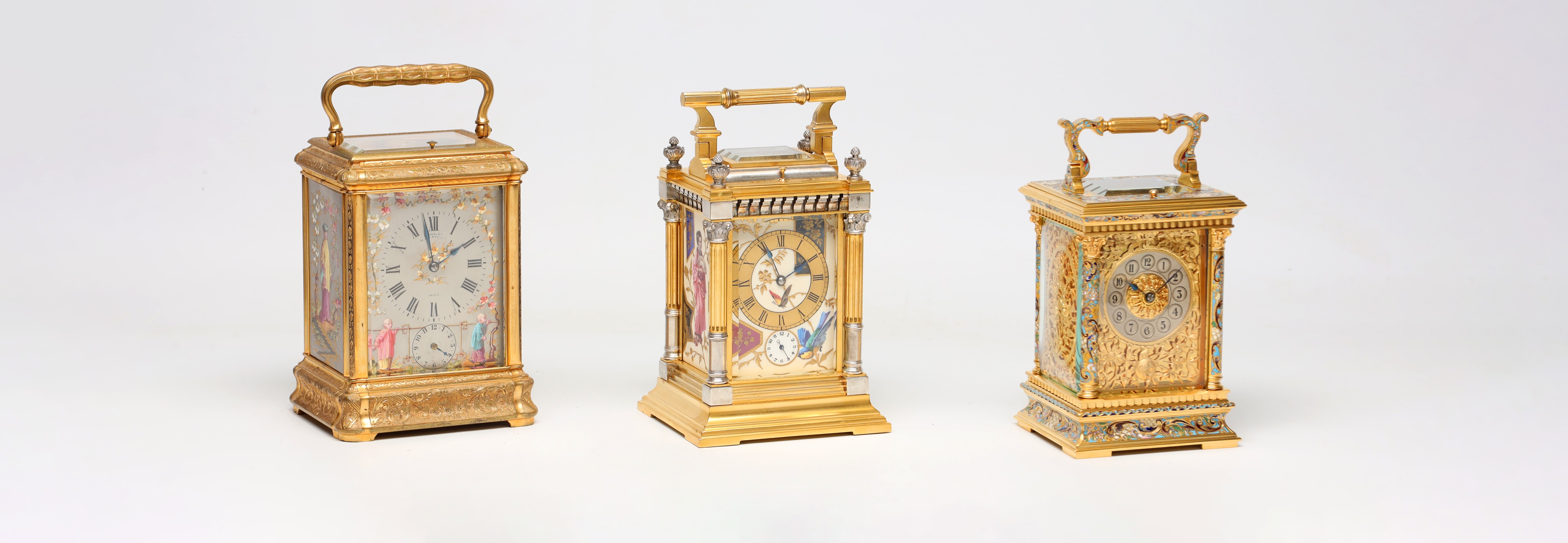
Collectors searching for antique carriage clocks at auction will find a strong selection in this specialist sale. Carriage clocks were designed to combine portability with dependable timekeeping, typically using glazed brass cases and platform escapements. More complex examples may include alarms, repeat mechanisms, striking trains, grand sonnerie work, enamel decoration or porcelain panels.
Among the names most closely associated with high-quality 19th-century carriage clocks are Drocourt, Henri Jacot, Arsène Margaine and Joseph Soldano. Their work is admired for precise movements, distinctive case designs and finely executed decorative finishes. The catalogue also includes clocks retailed by important names such as Tiffany & Co, as well as an Arts and Crafts example designed by Archibald Knox for Liberty & Co.

George Littlewort, London. An exceptionally rare early 19th-century General Post Office mail guard's travelling clock.
Estimate: £3,000–£5,000
View Lot
A large and fine Art Deco silver and guilloche enamel grand sonnerie minute-repeating carriage clock.
Estimate: £15,000–£25,000
View Lot
A late 19th-century French champlevé enamel repeating carriage clock.
Estimate: £2,500–£3,500
View Lot
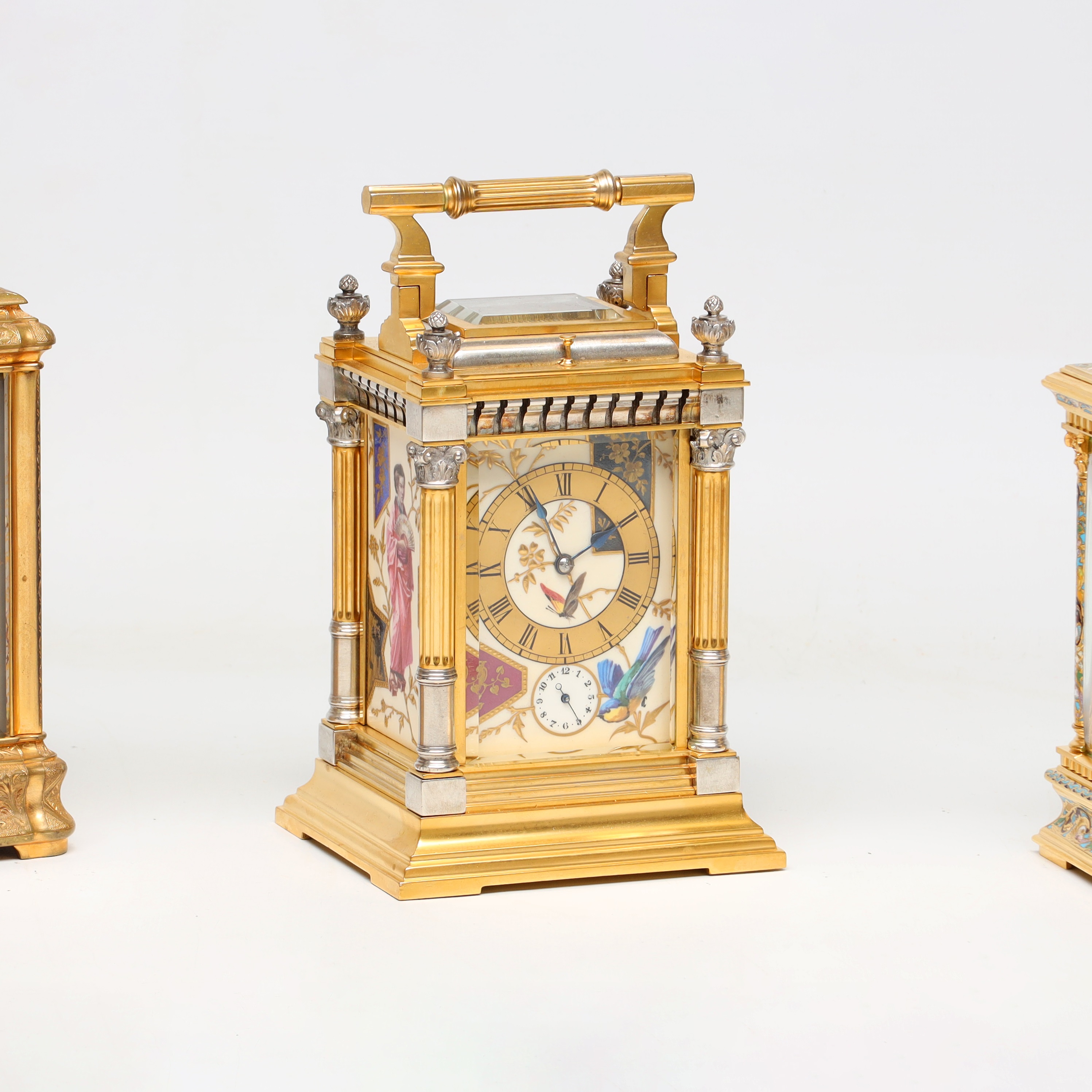
This late 19th-century carriage clock has an engraved gilt gorge case and porcelain panels painted with Oriental figures and flowering branches. Its signed dial fronts an eight-day movement with compensated lever escapement, striking, repeat and alarm mechanisms, and the clock retains its original Moroccan leather case.
Estimate: £5,000–£8,000
View Lot 38For buyers looking for antique longcase clocks for sale, this auction includes examples in walnut, mahogany, oak and marquetry, with movements ranging from traditional eight-day mechanisms to musical, calendar and moonphase complications. Often called grandfather clocks, longcase clocks unite cabinetmaking, dial design and mechanical engineering in a single imposing object.
Thomas Tompion, George Graham and Joseph Windmills remain important names in the history of English clockmaking. Their influence helped establish London as a centre of precision horology. Regional makers also developed distinctive traditions, and collectors regularly study signatures, dial layouts, movement construction and case proportions when identifying an antique longcase clock.

John Dobbie, Calton, Glasgow. A rare George III shield-shaped painted-dial inlaid mahogany eight-day longcase clock.
Estimate: £1,000–£1,500
View Lot
John Burges, Wigan. A rare George II spherical moonphase longcase clock.
Estimate: £5,000–£8,000
View Lot
T. J. Upjohn, London. A George III figured mahogany regulator longcase clock.
Estimate: £6,000–£8,000
View Lot
This imposing mahogany longcase clock has a swan-neck pediment, painted and carved hood and a 14-inch dial with centre seconds, concentric year calendar and tune-selection dial. The arch depicts the Battle of the Nile with a rocking ship between two fleets beneath a rotating spherical moonphase.
Its substantial three-train, eight-day weight-driven movement has deadbeat escapement, plays six tunes on thirteen bells and strikes the hours on a larger bell.
Estimate: £8,000–£12,000
View Lot 41The sale presents an impressive selection of antique bracket clocks at auction, including verge, double-fusee, quarter-repeating, quarter-chiming and musical examples. Bracket clocks can reveal exceptional skill in both movement finishing and cabinetmaking, with cases in ebony, walnut, mahogany, satinwood and lacquer.
Collectors of English bracket clocks often seek work connected with makers such as Thomas Tompion, George Graham, Eardley Norton, Barraud and Vulliamy. The current catalogue includes signed examples by Barraud and Eardley Norton alongside clocks by numerous London and provincial makers. A clear signature, original movement, period case and interesting complications can all contribute to desirability.

Edward Harley, London. A George III satinwood double-fusee bracket clock with ormolu quarter columns.
Estimate: £3,000–£5,000
View Lot
Richard Vick, London. A George II ebonised musical bracket clock.
Estimate: £5,000–£8,000
View Lot
William Webster, London. A fine early 18th-century walnut and marquetry triple-fusee six-bell quarter-striking verge bracket clock.
Estimate: £4,000–£6,000
View Lot
The architectural rosewood case has a pediment top, applied brass stringing and a stepped plinth base. Its eight-inch silvered engraved Roman dial is signed Vulliamy, London, with recessed seconds and subsidiary dials for strike/silent and regulation.
The signed eight-day chain-driven triple-fusee movement has a rise-and-fall deadbeat escapement, quarters chiming on eight bells and the hours striking on a larger bell. It retains its original numbered pendulum.
Estimate: £10,000–£15,000
View Lot 158Collectors searching for antique lantern clocks at auction will find notable examples spanning the early and late 17th century in The Fine Clock Sale. Recognised by their brass frames, large bells, pierced frets and weight-driven movements, lantern clocks occupy an important place in the development of English domestic horology. Surviving clocks can display single iron hands, alarm discs, verge escapements and engraved chapter rings, making originality, maker, date and movement construction especially important to collectors.
Important names associated with English lantern clocks include Peter Closon, Joseph Knibb, Nicholas Coxeter and provincial makers such as James Gray of Shaston. This specialist auction includes examples connected with each of these makers, allowing collectors to compare early London production with later regional clockmaking traditions. Signed dials, period frets, original bells and surviving striking or alarm work can all enhance the historical and mechanical interest of an antique lantern clock.

James Gray of Shaston, Shaftesbury. A rare late 17th-century provincial brass lantern clock.
Estimate: £3,000–£5,000
View Lot
Joseph Knibb, London. A William and Mary miniature striking verge lantern clock.
Estimate: £2,000–£3,000
View Lot
Peter Closon of London. A rare circa 1625–1630 first-period brass striking lantern clock.
Estimate: £4,000–£6,000
View Lot
The brass case has a strapped bell and turned finial, pierced foliate frets, corner finials and ball feet. Its silvered chapter ring has Roman numerals and half-hour markers, surrounding an engraved centre with an alarm-setting disc and a single iron hand.
The weight-driven two-train movement strikes the hours on the bell, while the front fret bears the date 1661.
Estimate: £3,000–£5,000
View Lot 77Research the maker and examine the online auction catalogue for information about the movement, escapement and complications. Repeating, chiming, musical, calendar and moonphase mechanisms can add considerable technical interest.
Original dials, hands, movements, pendulums, keys and cases are highly valued. Request a condition report and ask about alterations, restoration and whether the clock has been tested before bidding.
Fine cabinetmaking, unusual materials and documented provenance can make a clock especially appealing. Study photographs carefully and attend the viewing at Embsay Mills where possible.
Find answers to common questions about attending, viewing and bidding in The Fine Clock Sale, as well as requesting condition reports and specialist clock valuations from Hutchinson Scott.
The auction begins at 2pm on Tuesday 1 September 2026 at Hutchinson Scott, Embsay Mills, Skipton.
You can bid online, in person or by telephone. Register to bid online in advance and contact the auction team if you would like to arrange a telephone bid.
Yes. Viewing will take place at Embsay Mills ahead of the auction. Check The Fine Clock Sale page for the published viewing times.
Yes. Condition reports and additional information can be requested through the individual lot pages before the sale.
Yes. If you are considering selling an antique clock, submit a free auction valuation for specialist advice.
Whether you collect carriage clocks, longcase clocks, bracket clocks or unusual mechanical timepieces, The Fine Clock Sale offers an opportunity to discover exceptional horology from respected makers. Browse the full clock auction catalogue, request condition reports and register to bid ahead of the auction on 1 September 2026.
Whether you collect carriage clocks, longcase clocks, bracket clocks, lantern clocks or unusual mechanical timepieces, The Fine Clock Sale offers an opportunity to discover exceptional horology from respected makers. Browse the full clock auction catalogue, request condition reports and register to bid ahead of the auction on 1 September 2026.